No products in the cart.

A truly exceptional lighting fixture is rarely chosen from a catalogue. In the most considered interiors, light is designed with the architecture, shaped around the atmosphere, and finished with the same attention to detail as a piece of fine furniture or art.
This is the philosophy behind a bespoke lighting project, where a client’s vision becomes the starting point for something entirely individual.
At Blackcanvas, bespoke lighting is approached as a creative collaboration rather than a simple manufacturing exercise. Every commission moves through a carefully considered journey, from the first conversation and sketches to material selection, craftsmanship, finishing, and installation. The result is a fixture that does more than illuminate a room. It belongs to it.
Every bespoke commission begins with an idea. Sometimes it is a clear visual reference; sometimes it is simply an emotion the client wants the space to evoke.
A residence may call for a sculptural chandelier that becomes the centrepiece of a dining room, while a hospitality project may require a series of fixtures that create a distinctive identity across an entire property.
The first stage is therefore about listening.
A luxury lighting studio must understand not only what a client likes, but why they like it. Proportion, colour, texture, architecture, lifestyle, and the intended experience of the space all influence the direction of the design.
During these early conversations, important questions begin to shape the commission:
This client-led design approach ensures that the final piece feels personal rather than merely customised.
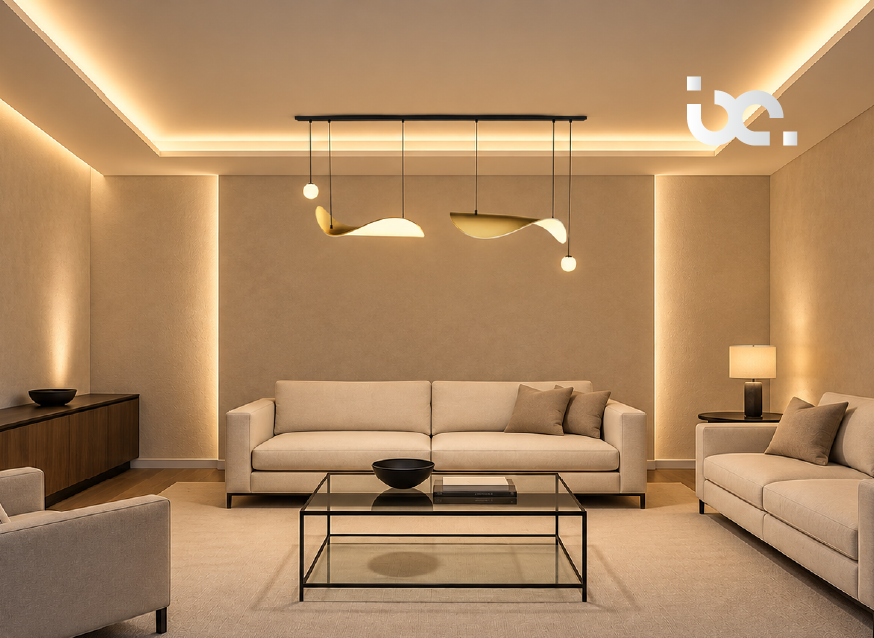
Once the vision is established, the creative process begins to give it form. This is where an initial thought becomes a considered design concept.
The designers may explore sketches, references, proportions, materials, silhouettes, and lighting effects before arriving at a direction that feels right. For a complex bespoke lighting project, several design iterations may be required.
The objective is not simply to make something unusual. It is to achieve balance.
A fixture may be sculptural, yet still need to sit comfortably within its surroundings. A dramatic chandelier may need to command attention without overwhelming the room. A delicate pendant may need to appear almost weightless while providing the required illumination.
These decisions require an understanding of both aesthetics and technical performance. The beauty of bespoke design lies in bringing the two together without compromising either.
The custom lighting process becomes increasingly detailed as the concept develops. Dimensions are refined, materials are evaluated, structural considerations are addressed, and the lighting performance is carefully considered.
At this stage, the team may develop detailed drawings and specifications covering elements such as:
This level of detail is particularly important when a fixture is being created specifically for an architectural setting. Even the smallest adjustment can change how a piece relates to its surroundings.
The process is therefore collaborative. Designers, craftspeople, architects, interior designers, and technical specialists may all contribute to refining the final solution.
Material selection is one of the most expressive stages of handcrafted lighting. Brass, metal, glass, stone, fabric, wood, and other materials can dramatically alter how a fixture looks and feels.
In luxury interiors, material is rarely chosen simply because it is attractive. Its texture, weight, reflectivity, colour, ageing characteristics, and relationship with surrounding finishes all matter.
A brushed metal surface may introduce quiet sophistication, while polished finishes can create a more dramatic presence. Textured glass can soften the quality of light, while translucent materials can create an ethereal glow.
For a bespoke lighting project, these choices can be highly specific. A particular brass tone may be developed to complement architectural hardware. A glass finish may be selected to echo decorative elements elsewhere in the room.
This attention to material creates continuity between the fixture and the larger interior.
Once the design has been approved, the concept enters production. This is where craftsmanship becomes central.
Handcrafted lighting requires patience and precision. Depending on the design, individual components may be cut, shaped, cast, formed, polished, assembled, and finished before becoming part of the completed fixture.
Unlike mass-produced lighting, bespoke fixtures often involve processes that cannot simply be reduced to a standard production line. Skilled craftspeople may need to interpret drawings, make precise adjustments, and respond to the characteristics of individual materials.
This human involvement is part of what gives a bespoke piece its character.
The craftsmanship should not necessarily announce itself. In the finest work, technical complexity becomes almost invisible, leaving behind an object that appears effortless.
Finishing is an important stage in creating luxury lighting. The surface treatment can influence how a fixture responds to both daylight and artificial illumination, changing its appearance throughout the day.
Depending on the design, a piece may require polishing, brushing, patination, plating, powder coating, lacquering, or another specialised finish. Each requires careful control.
A high-quality finish should complement the form rather than distract from it. It should also be appropriate for the environment in which the fixture will live.
This is where the custom nature of a commission becomes especially evident. Rather than selecting from a fixed palette, the client and design team can work towards a finish that feels uniquely suited to the project.
A beautiful fixture still needs to perform beautifully.
Before a bespoke fixture reaches its final destination, technical checks are essential. Light distribution, electrical components, structural integrity, heat management, dimensions, and installation requirements all need to be considered.
The design may also be reviewed in relation to the intended lighting effect. The quality of light matters as much as the object producing it.
For residential interiors, the goal may be a warm, intimate glow. In a hospitality environment, the fixture may need to contribute to a layered lighting scheme. In a dramatic entrance, it may need to create a strong visual statement while maintaining comfortable illumination.
The finished piece therefore represents a meeting point between design and engineering.
One of the greatest advantages of bespoke lighting is the ability to create a fixture according to the exact proportions of a space.
A standard fixture may be beautiful but still feel too small for a double-height room or too imposing above a compact dining table. Bespoke design allows dimensions to be considered from the beginning.
Scale influences how a fixture is perceived from across the room, while proportion determines how comfortably it relates to furniture, architecture, and surrounding objects.
For this reason, a bespoke commission can be particularly valuable in:
The result is lighting that feels as though it was always meant to be there.
The final installation is the moment when drawings, materials, craftsmanship, and light come together.
Installation requires careful coordination. Ceiling conditions, structural supports, electrical connections, access, fixture weight, and positioning all need to be considered before the piece is placed.
For large or intricate bespoke fixtures, installation can itself be a specialised process. Individual components may need to be assembled on site, with careful attention given to alignment and finishing.
Once illuminated, the fixture can finally be judged within its intended environment.
This is often where the original client vision becomes tangible. What began as a conversation or sketch now becomes part of the architecture.
There is an important difference between a customised product and a truly bespoke piece.
Customisation may involve changing a finish, size, or colour within an existing design. Bespoke work begins much earlier. The form itself can evolve around the client’s requirements, the architecture, and the desired experience.
That distinction is at the heart of Blackcanvas’s approach.
A bespoke lighting project is not simply about creating something different. It is about creating something that could not have been designed in quite the same way for another space.
The fixture becomes connected to its surroundings through proportion, material, craftsmanship, and light.
Luxury is increasingly defined by individuality and intention. In this context, bespoke lighting offers something that standard products cannot always provide: a sense of authorship.
A carefully designed fixture can become part of the identity of a residence, hotel, restaurant, or commercial environment. It can create a memorable first impression, enhance architectural details, and contribute to the emotional character of a room.
More importantly, it can remain meaningful long after trends have changed.
The finest bespoke fixtures are not designed simply to look impressive on installation day. They are designed to become enduring elements of an interior.
From the first conversation to the final illumination, a bespoke lighting project is an exercise in collaboration, precision, and imagination.
At Blackcanvas, every stage contributes to the finished experience: understanding the client, refining the concept, selecting materials, developing the custom lighting process, and bringing the design to life through handcrafted lighting.
The result is more than a source of illumination. It is a considered object shaped around a particular vision and a particular space.
For those seeking lighting with genuine individuality, bespoke fixtures offer an opportunity to move beyond what is readily available and create something deeply personal. In the hands of an experienced luxury lighting studio, that journey transforms an idea into an enduring piece of design.
A bespoke lighting project is a lighting commission created specifically around a client’s requirements, architecture, aesthetic preferences, dimensions, materials, and technical needs. Unlike standard products, the design can be developed from the concept stage.
The custom lighting process usually begins with a detailed discussion about the client’s vision, space, desired atmosphere, materials, dimensions, and practical requirements. These insights guide the initial design direction.
Handcrafted lighting involves skilled workmanship and detailed attention during the making and finishing of a fixture. Individual components can be carefully shaped, assembled, and refined to achieve a distinctive result.
Yes. Bespoke fixtures can be developed for spaces with unusual dimensions, architectural constraints, double-height ceilings, curved structures, or specific installation requirements.
The timeline varies according to the complexity of the design, materials, finishing requirements, technical development, and installation. A detailed project may require several stages of design and production before completion.
Experience radiant guidance tailored to your unique vision.